

From 15 to 17 June 2026, the side event “Protecting Development Gains: Leveraging Emerging Technologies and Space Applications for Resilient Development” was held in Shenzhen as part of the 7th BRICS Forum on Future Networks Innovation. Jointly organized by the United Nations Economic and Social Commission for Asia and the Pacific (ESCAP) and the China Branch of the BRICS Institute of Future Networks(BIFNC), the event brought together representatives from governments, research institutions and international organizations from China, Fiji, Indonesia, Thailand, Uzbekistan and other countries.
The International Mangrove Center (IMC) was invited to participate in the session “AI for Coastal Ecosystem Monitoring”, where it joined representatives from the Indonesian Space Agency (INASA), Tsinghua University, the University of Hong Kong and other institutions to exchange perspectives on the application of artificial intelligence and remote sensing technologies in mangrove monitoring, blue carbon research and coastal ecosystem conservation.
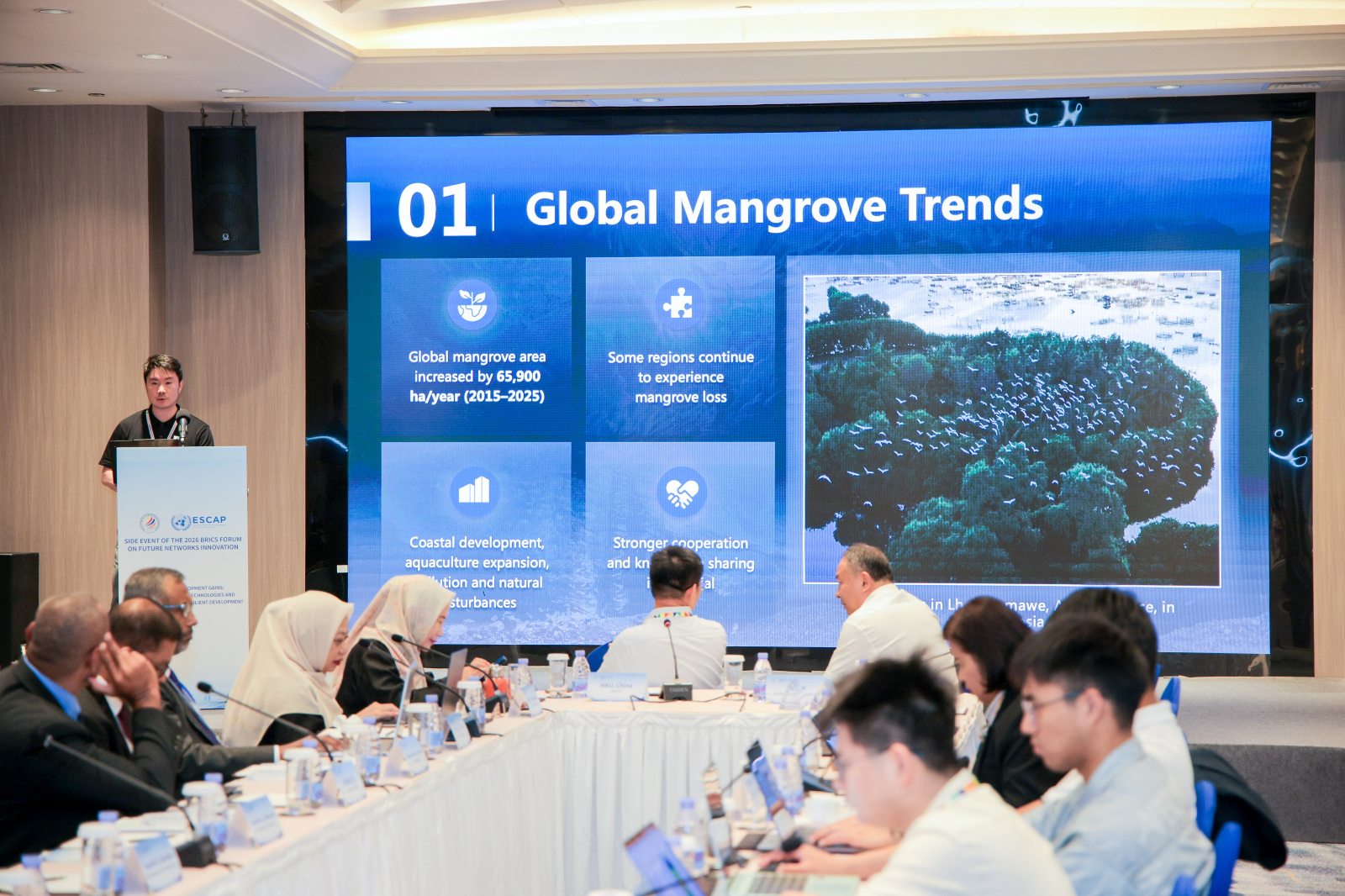
Photo: Representative of the IMC Interim Secretariat delivering a presentation at the side event
During the session, IMC delivered a presentation entitled “Advancing Mangrove Conservation and Coastal Resilience through Satellite Monitoring and International Cooperation”. The presentation highlighted the challenges facing mangrove ecosystems worldwide and introduced IMC’s development, mandate and ongoing work to support global mangrove conservation.
Mr.Peng Peng, Director of the Interim Secretariat of the IMC, emphasized that mangroves serve as critical coastal buffers, important blue carbon ecosystems and biodiversity hotspots. Strengthening international cooperation, knowledge exchange and capacity-building is therefore essential to advancing global efforts for mangrove conservation, restoration and sustainable use.
Mr.Peng also showcased IMC’s efforts to harness satellite remote sensing, artificial intelligence and digital technologies to support mangrove conservation. IMC has established a Global Mangrove AI Monitoring Platform, integrating satellite remote sensing, artificial intelligence and digital twin technologies to analyze global mangrove distribution and change trends. In addition, In addition, IMC is utilizing satellite remote sensing and GIS technologies to develop a range of knowledge products, including global and country-level mangrove datasets and thematic map atlases, to support evidence-based decision-making and conservation practice.
He further highlighted the growing potential of AI applications in coastal wetland conservation, migratory bird monitoring and ecological risk early warning, noting their value in strengthening transboundary ecological governance and regional cooperation.
Mangrove conservation is a shared global responsibility. As challenges such as climate change and ecosystem degradation increasingly transcend national boundaries, international cooperation remains vital for sharing knowledge, technologies and innovative solutions. Through its role as a global platform for cooperation, IMC continues to promote partnerships, knowledge exchange and the application of emerging technologies to support mangrove conservation and enhance the resilience of coastal ecosystems worldwide.